
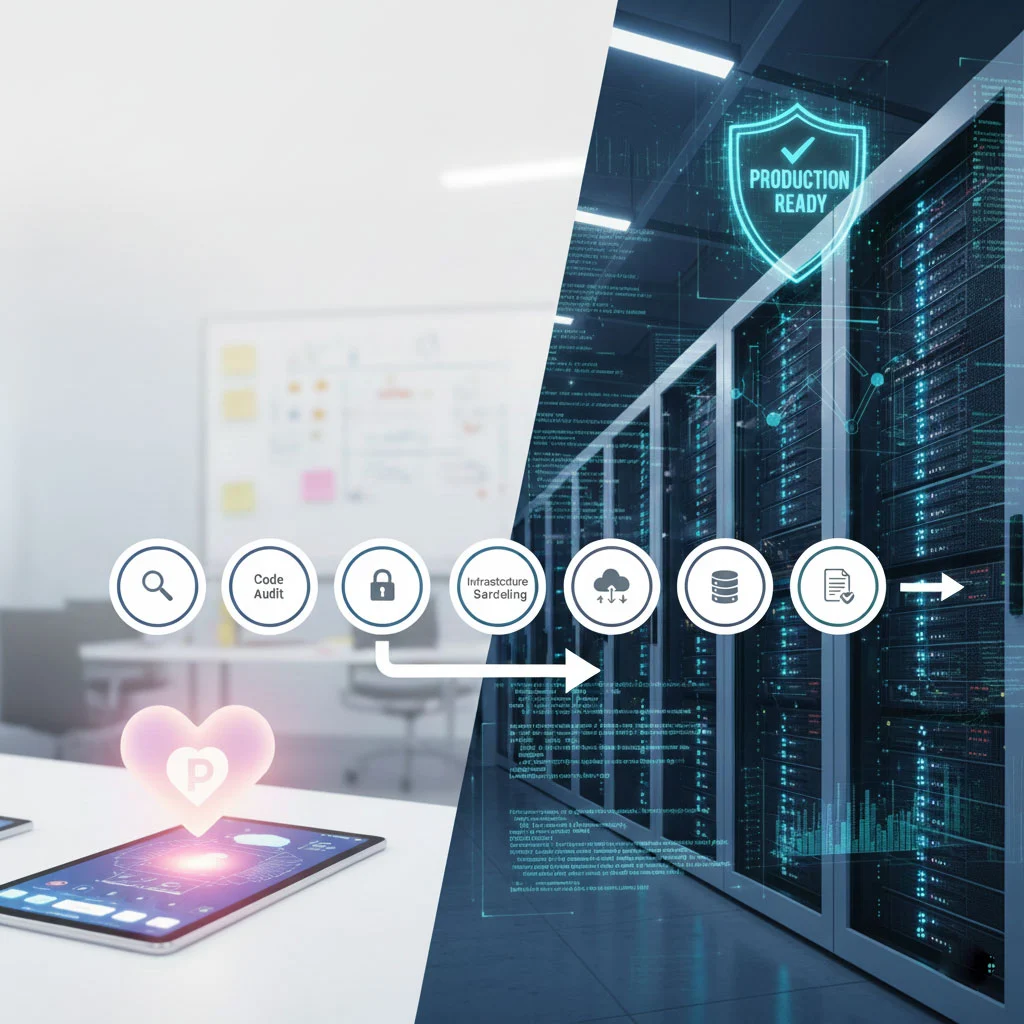
You've done it. You've taken an idea and, with the incredible speed of Lovable, turned it into a functional, impressive prototype. It looks great, it works in the demo, and you're rightfully excited. But now, you've hit an invisible wall. The path from this promising prototype to a real, revenue-generating business seems unclear and fraught with technical hurdles. You're experiencing the Prototype Paradox: the very tools and shortcuts that enabled your rapid progress are now the biggest obstacles to launching a secure, scalable, and professional application.
This isn't a unique problem. Many founders and developers find themselves stuck at this exact stage. The journey from a low-code prototype to a production-ready system is a well-documented challenge, filled with pitfalls in security, performance, and scalability that can derail a project if not handled correctly. This guide provides a clear, actionable roadmap, breaking down the 7 critical steps required to bridge that gap and transform your Lovable prototype into a business-ready application.
The Hard Truth: Why Your Lovable Prototype Isn't Production-Ready
Lovable is a phenomenal tool for validating ideas and building user interfaces at lightning speed. However, its primary optimization is for the speed of creation, not the rigors of production. Before diving into the solutions, it's crucial to understand the inherent limitations of a prototype-first approach. These issues generally fall into three categories: security gaps, performance bottlenecks, and scalability walls.
Community discussions and expert analyses reveal a consistent pattern of problems. Developers frequently report that while Lovable is excellent for frontend work, the generated code often requires a complete refactor for production use due to its complexity and potential for security flaws. A significant security incident involving over 170 apps highlighted how misconfigurations in the underlying database security (Row Level Security) can lead to critical data vulnerabilities.
To illustrate the difference, consider the following comparison:
Lovable Prototype vs. Production-Ready App Comparison
| Feature | Lovable Prototype | Production-Ready App |
|---|---|---|
| Load Time | 3-5 seconds | Under 1 second |
| Concurrent Users | Handles 5-10 users | Supports 1,000+ users |
| Security | Basic, often with exposed keys | Hardened, with multi-layer protection |
| Database | Local or basic, no backups | Scalable cloud DB with disaster recovery |
| Authentication | Mock profiles, insecure | Secure, with OAuth and role-based access |
These are not minor details; they are the foundational elements that separate a demo from a dependable service.
The 7 Critical Steps to Go From Prototype to Production
Navigating the transition from prototype to production requires a structured, engineering-led approach. The following seven steps represent a comprehensive roadmap for building a robust and scalable application on top of your Lovable foundation.
Step 1: Comprehensive Code Audit & Optimization
The first step is always to perform a deep-dive code audit. Lovable's AI-generated code, while functional, is not optimized for production performance or maintainability. An audit by an experienced developer will identify critical issues such as performance bottlenecks (e.g., unnecessary re-renders), security vulnerabilities like exposed API keys, and fundamental scalability problems like hard-coded limits or poor state management.
This process isn't about criticizing the prototype; it's about creating a professional baseline for all future development.
Step 2: Architecting a Scalable Production Infrastructure
A prototype's hosted environment is not designed for public traffic. A production application requires a dedicated, scalable infrastructure. This involves setting up a custom domain with proper SSL certificates for security and user trust. Furthermore, a global Content Delivery Network (CDN) should be configured to ensure your application loads quickly for users anywhere in the world. Finally, the application must be moved from a shared or limited environment to a scalable cloud infrastructure (like AWS, Google Cloud, or Azure) that can handle traffic spikes without crashing.
Step 3: Implementing a Robust User Authentication System
Mock user profiles are sufficient for a demo, but a real application needs a secure and reliable authentication system. This is a non-trivial task that is often underestimated. A production-grade authentication system includes:
- Secure user registration and login flows
- Email verification and password reset functionalities
- Social logins through OAuth (e.g., Google, GitHub)
- Role-based access control (RBAC) to ensure users can only access the data and features they are permitted to
Crucially, this logic must be handled on the server-side to be secure.
Step 4: Professional Database Design & Migration
Prototypes often rely on local storage or a very basic database structure that lacks persistence, backups, and the ability to handle multiple users at once. A production application requires a robust, scalable cloud database like PostgreSQL or MongoDB.
This step involves:
- Designing a proper data model with clear relationships between data entities
- Migrating any existing prototype data
- Implementing automated backup and disaster recovery plans
As one developer noted, a key challenge is that once you have paying customers, you cannot risk corrupting or losing their data due to a fragile database structure.
Step 5: Integrating Secure Payment Processing
If your business model involves any form of payment, integrating a professional payment processing system is non-negotiable. This is a complex and highly regulated area that cannot be handled within a simple prototype.
Integrating a service like Stripe is the industry standard, but it involves more than just adding a button. It requires careful implementation to ensure:
- PCI DSS compliance
- Secure handling of sensitive financial data
- Robust management of subscriptions, invoicing, and refunds
Step 6: Critical Security Hardening
Security cannot be an afterthought. Lovable prototypes, by their nature, are not built with production-level security in mind. A thorough security hardening process is essential to protect your users and your business.
This includes:
- Moving all validation logic from the client-side to the backend (Edge Functions)
- Securing all API endpoints
- Encrypting sensitive data both in transit and at rest
- Implementing measures to protect against common web vulnerabilities like SQL injection and Cross-Site Scripting (XSS)
Step 7: Performance Tuning & Load Testing
Finally, your application must be tested to ensure it can withstand the pressures of real-world usage. A prototype that works for a single user will often crash when faced with even a small number of concurrent users.
Performance tuning aims to optimize the application for speed, with a goal of achieving sub-second load times. Following this, load testing simulates high traffic conditions to identify and fix breaking points before your real users do, ensuring your app can scale from its first ten users to its first ten thousand.
The DIY Dilemma: Can You Tackle This Alone?
Faced with this list, the entrepreneurial spirit often asks, "Can't I just learn to do this myself?" While admirable, this path is often more costly than it appears:
- Learning Curve: The learning curve for production-grade deployment, security, and scaling is steep, often taking 6-12 months of dedicated effort
- Opportunity Cost: During this time, your competitors are focused on acquiring customers and capturing the market
- Hidden Complexity: Every seemingly simple feature often uncovers ten more complex underlying requirements
- Security Risks: Most importantly, a single security mistake can expose user data, destroying your reputation and business overnight
Your Path Forward
The journey from a Lovable prototype to a production-ready application is a well-defined engineering challenge, not an insurmountable obstacle. It requires a shift in mindset from rapid prototyping to disciplined, professional development. By following these seven critical steps, you can successfully navigate this transition and build a scalable, secure, and successful application.
Feeling overwhelmed? You don't have to do it alone. At Worksdelight, we specialize in transforming promising Lovable prototypes into robust, market-ready applications. Our team of expert developers can audit your code, architect a scalable infrastructure, and implement the critical features you need to launch with confidence.
If you're ready to cross the bridge from prototype to production, contact us today for a free consultation and code review.